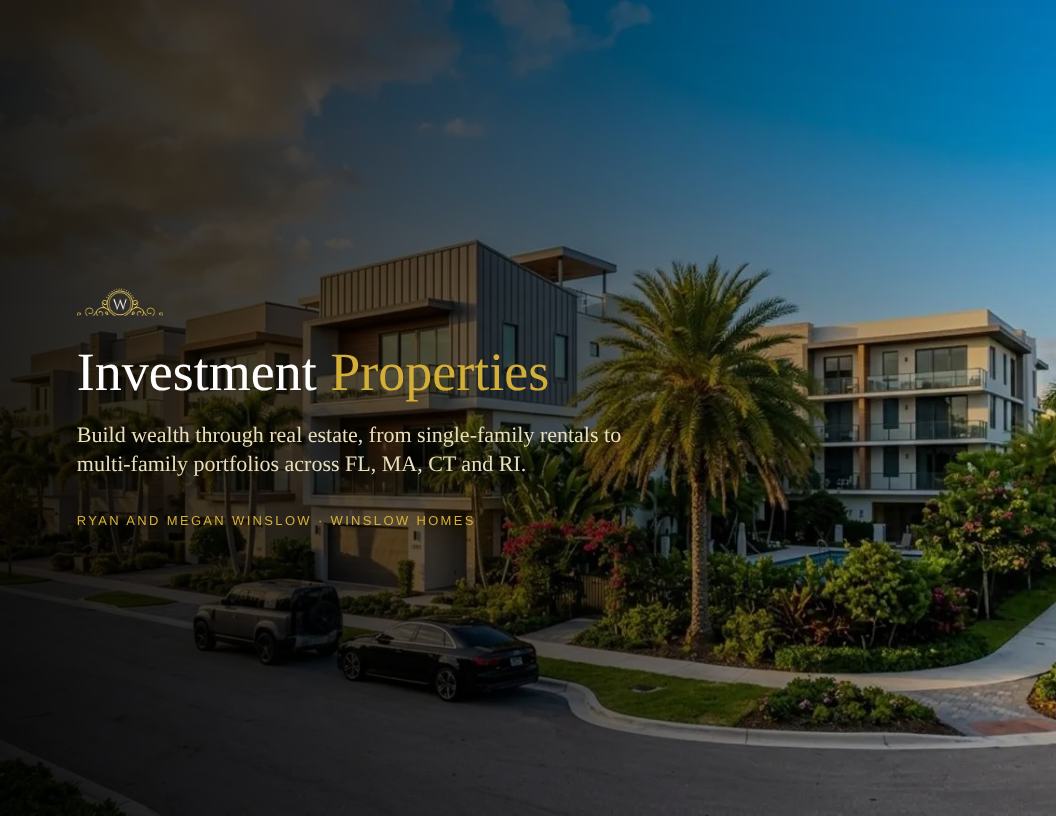
Investment Properties Guide
Build wealth through real estate , from single-family rentals to multi-family portfolios across Florida, Massachusetts, Connecticut, and Rhode Island.
Why Invest in Real Estate?
Real estate remains one of the most reliable wealth-building strategies in America. Unlike stocks or bonds, investment properties provide four distinct paths to building wealth simultaneously: monthly cash flow from rental income, long-term appreciation as property values rise, tax advantages through depreciation and deductions, and equity buildup as tenants pay down your mortgage.
Whether you are a first-time investor looking at a single rental property or an experienced investor expanding a multi-state portfolio, Winslow Homes provides the market expertise, deal analysis, and financing guidance you need to make informed investment decisions.
📈 The Power of Leverage
Real estate is one of the few asset classes where you can control a $400,000 asset with as little as $80,000 down (20%). If that property appreciates 5% in a year, your $20,000 gain represents a 25% return on your invested capital , before factoring in rental income, tax benefits, and mortgage paydown. This leverage effect is what makes real estate investing so powerful for building long-term wealth.

Four Ways Real Estate Builds Wealth
Investment Property Types
Understanding the different types of investment properties helps you choose the right strategy for your goals, budget, and risk tolerance.
🏡 Single-Family Rentals
The most common entry point for investors. Strong demand in suburban markets across all four states. Typical cap rates of 5–8% depending on market and condition. Easier to finance and manage than multi-family properties. Tenants typically stay longer and take better care of the property.
🏖 Short-Term / Vacation Rentals
Florida’s tourism market makes short-term rentals extremely profitable. Beach communities in Daytona Beach, New Smyrna Beach, and Flagler Beach generate premium nightly rates. Newport and Cape Cod also command strong seasonal premiums. Higher income potential but more active management required.
🏘 Multi-Family Properties
Duplexes, triplexes, and fourplexes let you house-hack or scale rental income. Massachusetts three-deckers and Rhode Island multi-families offer strong cash flow. FHA and VA loans allow you to buy up to 4 units if you live in one , often with as little as 3.5% down.
🔨 Fix-and-Flip
Buy undervalued properties, renovate, and sell at a profit. Requires strong market knowledge, reliable contractors, and accurate renovation budgets. Our contracting background helps you evaluate renovation costs realistically and avoid overpaying for properties that need work.
🏗 New Construction Investments
Purchase new construction properties at pre-construction prices, then rent or sell at completion for immediate equity. Builder incentives like rate buydowns and closing cost credits improve your return on investment from day one.
🏪 Commercial / Mixed-Use
Retail storefronts with residential units above , a popular configuration in New England downtowns and Florida’s growing commercial corridors. Higher cap rates and longer lease terms provide stable income, though financing requirements are typically more stringent.
Key Investment Metrics
Understanding these numbers is essential for evaluating any investment property. Your Winslow Homes agent will help you run these calculations on every property you consider.
| Metric | What It Measures | Target Range |
|---|---|---|
| Cap Rate | Annual net operating income divided by purchase price. Measures return without financing. | 5–10% (varies by market) |
| Cash-on-Cash Return | Annual pre-tax cash flow divided by total cash invested. Measures actual return on your money. | 8–12%+ |
| DSCR | Debt service coverage ratio , rental income divided by mortgage payment. Used by lenders to qualify loans. | 1.2x or higher |
| GRM | Gross rent multiplier , purchase price divided by annual gross rent. Quick screening tool. | 8–15 (lower is better) |
| 1% Rule | Monthly rent should be at least 1% of purchase price. Quick cash flow screening. | $3,500/mo on $350K property |
| Vacancy Rate | Percentage of time property is unoccupied. Budget for this in your projections. | 5–8% (market dependent) |
⚠ Common Investor Mistakes
The biggest mistakes new investors make include underestimating repair costs, ignoring vacancy rates in cash flow projections, buying based on projected rents rather than current market rents, and failing to account for property management costs (typically 8–10% of gross rent). Your Winslow Homes agent will help you build realistic projections that account for all expenses.
Investment Property Financing
Financing an investment property works differently than purchasing a primary residence. Here are the main loan options available for investors.
| Loan Type | Down Payment | Best For |
|---|---|---|
| Conventional Investment | 20–25% | Investors with strong W-2 income and good credit (700+). Standard rates, typically 0.5–0.75% higher than primary residence loans. Best option for first investment property. |
| DSCR Loan | 20–25% | Qualify based on property rental income rather than personal income. Ideal for scaling a portfolio or self-employed investors. No tax returns or employment verification required. |
| FHA (2–4 Units) | 3.5% | Owner-occupied multi-family (live in one unit, rent the others). Rental income from other units helps you qualify. One of the best ways to start investing with minimal money down. |
| VA (2–4 Units) | 0% | Veterans can buy up to 4 units with zero down payment if they occupy one unit. Remaining units generate rental income. The ultimate house-hack strategy for eligible veterans. |
| Hard Money / Bridge | 10–30% | Short-term financing for fix-and-flip projects. Quick closing timelines (7–14 days). Higher rates (10–14%) but fast access to capital when speed matters. |
| Portfolio Loan | 20–30% | For investors with 5+ properties who have exceeded conventional loan limits. Flexible underwriting based on overall portfolio performance rather than individual property. |
💡 House-Hacking Strategy
Buy a 2–4 unit property with an FHA loan (3.5% down) or VA loan (0% down), live in one unit, and rent the others. The rental income covers most or all of your mortgage payment. After one year, you can move out and keep it as a full investment property , then do it again with another FHA or VA loan. This is the fastest way to build a rental portfolio with minimal capital.
Explore Investment Financing
Whether you need a conventional investment loan, DSCR, or house-hack financing, the Winslow Homes mortgage team specializes in investment property lending.
Get Pre-Approved → Call (386) 690-5858Top Investment Markets by State
Each state we serve has distinct advantages for real estate investors. Here is what you need to know about investing in each market.
🌞 Florida
Florida’s population growth, tourism economy, and landlord-friendly laws make it the top state for real estate investors. No state income tax means more of your rental income stays in your pocket.
Short-term rental opportunities are especially strong in beach communities. Long-term rentals benefit from consistent population growth and a large renter demographic. The I-4 corridor between Orlando and Tampa offers some of the strongest appreciation potential in the state.
🍃 Massachusetts
Massachusetts has consistently strong rental demand driven by its university population, healthcare sector, and tech industry. The South Shore and Fall River/New Bedford areas offer the best price-to-rent ratios in the state.
Three-decker properties are a Massachusetts specialty , purpose-built three-unit buildings that offer strong cash flow at accessible price points. College towns provide reliable tenant pools with predictable lease cycles.
🍀 Connecticut
Connecticut’s proximity to NYC creates steady rental demand in Fairfield County, while Hartford and New Haven offer more affordable investment entry points with solid returns. University communities around Yale and UConn provide consistent tenant demand.
Mixed-use properties in Connecticut’s charming downtown districts offer both commercial and residential income streams. The state’s ongoing revitalization efforts are driving appreciation in previously undervalued markets.
⛵ Rhode Island
Rhode Island’s compact size and university presence (Brown, URI, Providence College) create reliable rental demand. Newport vacation rentals command premium seasonal rates that can cover an entire year’s mortgage in just a few months.
Proximity to both Boston and New York job markets makes Rhode Island attractive for commuters, while relatively affordable property prices compared to Massachusetts create stronger cash-on-cash returns for investors.
What Your Investment Agent Does for You
Working with an agent who understands investment property is critical. Most residential agents lack the knowledge to properly evaluate investment deals. Here is what your Winslow Homes investment specialist provides.
📊 Deal Analysis
We run cap rate, cash-on-cash return, and DSCR calculations on every property you consider. You will never buy based on guesswork or overly optimistic projections.
📈 Market Rent Research
We analyze current rental comps in the area to verify realistic income projections , not wishful thinking from listing agents or property managers.
📝 Contract Negotiation
Investment property negotiations focus on different priorities than residential purchases. We negotiate inspection contingencies, rent roll verification, and estoppel agreements to protect your investment.
💰 Financing Strategy
We connect you with lenders who specialize in investment property financing , including DSCR, portfolio, and house-hack loans that traditional lenders may not offer.
🛠 Renovation Assessment
With our construction background, we evaluate renovation costs accurately , helping you avoid overpaying for fix-and-flip or value-add opportunities.
🚀 Portfolio Strategy
We help you develop a long-term acquisition plan aligned with your financial goals, whether you are building a local portfolio or diversifying across multiple states.

Frequently Asked Questions
Start Building Your Real Estate Portfolio
Whether it is your first rental or your fiftieth, our investment-savvy agents and mortgage team will find the right opportunity for your goals.
Get Pre-Approved → Call (386) 690-5858