Compare taxes, insurance and living costs, then sell in Massachusetts and buy in Florida on one timeline.
Reviewed and updated October 3, 2026 by Ryan and Megan Winslow, Winslow Homes
You are thinking about trading Massachusetts winters for Florida sunshine. You are not the first. Ryan and Megan Winslow made the same move with their own family, from Massachusetts to Florida.
Ryan and Megan have worked as REALTORS® since 2009. Today they are broker owners licensed in Florida, Massachusetts, Connecticut and Rhode Island, with more than 3,000 homes sold. They are also Mortgage Bankers with The Federal Savings Bank. This guide covers the taxes, insurance and costs you should weigh, and how to sell in one state and buy in the other without a gap.
Florida's constitution bars a state income tax on individuals (source, checked October 2026). Massachusetts taxes most income at 5%, and for tax year 2026 it adds a 4% surtax on income above $1,107,750 (source, updated December 2025).
Here is the simple math. A household with $150,000 of taxable Massachusetts income at 5% owes about $7,500 in state income tax. In Florida, that line drops to zero. Your federal tax stays the same.
Estate planning changes too. Massachusetts requires an estate tax return for estates over $2,000,000 for deaths on or after January 1, 2023 (source, checked October 2026). Florida does not levy a state estate tax. Talk with your tax advisor and estate attorney about when and how to change your legal residence. Moving your driver's license, voter registration, car registration and homestead all help show where you live.

When you own and live in your Florida home as your permanent residence, you qualify for a homestead exemption.
Timing matters. If you close on December 30, you qualify for that next January 1. If you close on January 2, you wait almost a full year for the exemption.

Save Our Homes limits how fast the assessed value of a homesteaded home rises each year. The cap is 3% or the change in the Consumer Price Index, whichever is lower (source, checked October 2026). For 2026, the cap is 2.7% (source, checked October 2026).
So if the market value of your home jumps 8% in a year, your assessed value for taxes rises no more than 2.7%. Over many years, that gap grows into real savings.
If you later move to another Florida home, portability lets you carry up to $500,000 of your accumulated Save Our Homes benefit to the new homestead within three tax years (source, checked October 2026). One warning: when you buy a home, the seller's capped value resets. Budget for taxes on your purchase price, not the seller's tax bill.
This is the cost that surprises most people moving south. Insurance.com put the average Florida home insurance premium at $8,471 per year in September 2026, compared with $2,112 in Massachusetts, for a policy with $300,000 in dwelling coverage (source, September 2026).
Flood is separate. If you insure through Citizens Property Insurance Corporation, flood coverage is required for residential policyholders with wind coverage, except condo unit owners, and the requirement reaches all remaining qualifying homes on January 1, 2027 (source, checked October 2026).
Your quote depends on the home. Newer roofs, impact windows, concrete block construction and higher elevation all lower your cost. Ryan and Megan ask for the roof age, the wind mitigation report and the flood zone early, so you see the full monthly cost before you make an offer.

Overall prices run somewhat lower in Florida. The federal Bureau of Economic Analysis measures regional price levels against a national average of 100. For 2024, Florida measured 103.4 and Massachusetts measured 105.8 (source, Florida, updated February 2026) (source, Massachusetts, updated February 2026).
Home prices show a bigger gap. The Massachusetts median single-family price was $715,000 in June 2026, per the Massachusetts Association of Realtors (source, June 2026). The Florida median single-family price was $415,000 in August 2026 (source, August 2026).
That gap helps many Massachusetts sellers buy a Florida home with cash to spare or a smaller loan. Remember to weigh it against higher insurance and, in some communities, association dues.

Massachusetts buyers spread across the state, and each region brings its own tradeoffs.
Think about what you will miss and what you want. Many New England buyers want seasons, so they visit in summer before they commit. Others want a direct flight back to Boston for family visits. Ryan and Megan help you weigh school options, commute times, airport access and insurance costs for each area before you narrow your search.
Plan a scouting trip with a short list of two or three areas. Tour homes in each one in a single weekend, and drive from each area to the places you will visit most. That trip often settles the decision faster than months of online browsing.
The hardest part of this move is timing. You want your Massachusetts sale and your Florida purchase to line up, so you avoid two mortgages or a stretch with no home.
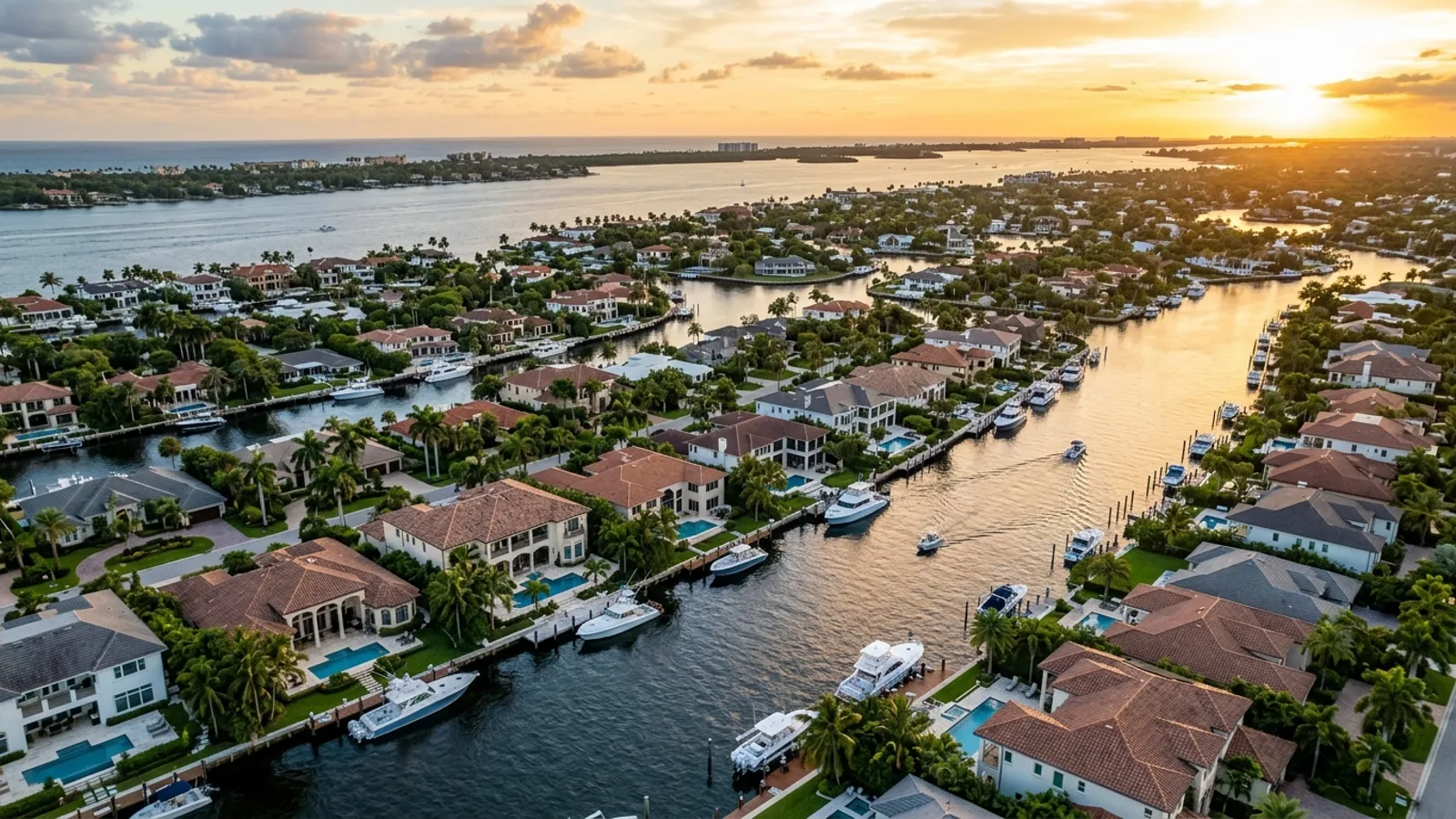
Most agents work in one state. Ryan and Megan are licensed brokers in both Massachusetts and Florida, so one team handles your sale and your purchase. You get one plan, one timeline and one point of contact.
They know both markets from the inside. Ryan and Megan worked in Massachusetts real estate for years, then moved their family to Florida. They understand the questions you face because they faced them too: which town fits, how insurance works, how to time the move around school and work.
Their mortgage side helps as well. As Mortgage Bankers with The Federal Savings Bank, Ryan and Megan help you plan your financing alongside the sale and purchase, so your numbers line up from the start.

No. Florida's constitution bars a state income tax on individuals (source, checked October 2026).
You get $25,000 off all property taxes plus an additional exemption on non-school taxes of up to $26,411 for 2026 (source, 2026 tax year).
The 2026 cap on annual assessed value increases for homesteaded homes is 2.7% (source, checked October 2026).
Yes. Insurance.com put the Florida average at $8,471 per year and the Massachusetts average at $2,112 in September 2026, for $300,000 in dwelling coverage (source, September 2026).
Yes, when the agent holds licenses in both states. Ryan and Megan are licensed brokers in Massachusetts and Florida, so one team runs both sides of your move.
Call Ryan and Megan at 386-690-5858, book a free consultation, or start with a Massachusetts home value report. They build one timeline for your sale and your Florida purchase.